Backend Developer Roadmap

Last published March 14, 2026
Table of Contents
So you’ve decided you want to learn backend development so you can get a job - congratulations! Many self-taught coders have a hard time deciding between all the various programming job options, but it’s much easier to learn effectively if you have a clear backend developer roadmap to follow.
Want to master back-end development from start to finish?
VIEW THE LEARNING PATHBefore we get started, if you want the quick answer, check out Boot.dev - it’s a platform built from the ground up to teach backend development completely online. You will never learn to become a backend developer just by reading a blog post. Instead of trying to teach you backend development in just this post, I’ll offer a deep dive into the things you need to learn. If that sounds useful, read on.
Below, we’ll cover everything you need to learn backend development, from knowing nothing about programming to getting your first job as a backend developer. This backend developer roadmap is a compilation of my own experience and expertise as a backend engineer and hiring manager, as well as the experience of other backend experts I’ve consulted.
First, what is a backend developer?
A backend developer is just one of many kinds of programmers. Backend developers build and maintain the systems that store, process, and secure the data used by websites and apps. This is in contrast to front-end developers, who control everything you see and interact with directly in your browser or on a mobile app.
In short, a backend developer concerns themselves with servers, while front-end developers work on clients.
Some of the most common job titles for programmers include:
- Frontend developer
- Backend developer
- Mobile developer
- Game developer
- DevOps specialist
- Data scientist
If you enjoy working on problems that involve algorithms, data structures, natural language processing, databases, or distributed systems, then backend development might be for you. Backend roles tend to attract developers who care more about how systems behave under load than how they look on a screen.
That depth of technical knowledge is one reason backend skills stay in demand. According to Stack Overflow’s latest developer survey, backend developers in the US tie for the highest median salary in this group at $175,000.
Can I learn backend development by myself?
Many people assume that because backend developers need a strong understanding of computer science fundamentals, it’s harder to get an entry-level backend position. As a result, they educate themselves on front-end web development as a workaround. I think this is a mistake.
Learning frontend development as a stepping stone often pulls people in the wrong direction. Front-end roles prioritize different skills like UI, styling, and browser behavior. Time spent there doesn’t always translate well to backend interviews, which focus more on data structures, system behavior, and problem-solving.
Besides, just because CS skills are often required for backend positions, it’s almost never true that a CS degree is required. If you take the learning path outlined below, there’s no need to go back to university.
The learning path: backend developer roadmap
Alright, now that we’ve answered some preliminary questions, let’s get onto the learning path.
Follow these steps in order. Some resources mentioned are paid, and some are free.
1. Learn basic coding skills
Learning the syntax of a coding language is fun, and it’s exciting when you get up and running almost immediately. Your goal at this stage should be to understand the basic syntax of one programming language. Python is my favorite choice because of its elegant and simple style.
You should learn concepts like:
- Variables and data
- Comparison operators
- Loops
- Lists
- Functions
- Dictionaries
- Errors and exceptions
These basic coding skills, whether learned through Python or another language, are a prerequisite to everything else you’ll learn.
Resources to learn basic coding skills
If you’re brand new, the goal isn’t immediate mastery. It’s getting comfortable writing code and understanding how basic pieces fit together.
- Boot.dev’s Learn Python
- Edabit JavaScript Challenges
- A Byte of Python
- The Python Tutorial
- Python for Everybody
- FreeCodeCamp’s Learn JS
2. Master data structures and algorithms
Learning coding fundamentals is quick and fun, but this next step usually takes longer.
Your goal here should be to learn computer science fundamentals. Go deep on common algorithms and data structures. Backend interviews are often full of questions on this topic because they test understanding, not copy-pasting ability.
As a backend developer, your job is to make sure server code is fast and performant.
Resources for data structures and algorithms
This part is less about memorization and more about learning how to think through problems.
3. Learn the basics of the web
Now that you understand coding fundamentals in at least one language, your goal is to understand the client-server model. You should come out of this step able to answer:
- How do I make HTTP requests?
- What is an HTTP server?
- How do webpages communicate with servers?
Your goal here is to understand why we need backend developers and how the internet works at a basic networking level. I’d recommend doing a couple of small front-end projects like these JavaScript projects for beginners so you can understand the backend server’s role in a web app.
Resources
Learn enough to see how requests move from a browser to a server and back.
4. Get started building simple web servers
Next, pick one or two languages to specialize in. For example, I’m primarily a backend Go engineer, but I dabble in Python and JavaScript. By specializing, you’ll make your job search easier. Companies hire experts for specific needs, not jack-of-all-trades developers.
Here are some projects to check out:
Learn backend concepts like:
- What an application programming interface (API) is
- REST architecture
- WebSockets
- GraphQL
Your goal is to build simple web servers that serve a purpose. Try building an API for something fun, like a PokeAPI clone or a wiki backend for your favorite TV show. I recommend waiting before using databases. Start with JSON files or in-memory storage first.
5. Learn database fundamentals
Almost every backend server in the world uses one or more databases to store information. A common architecture looks like this:
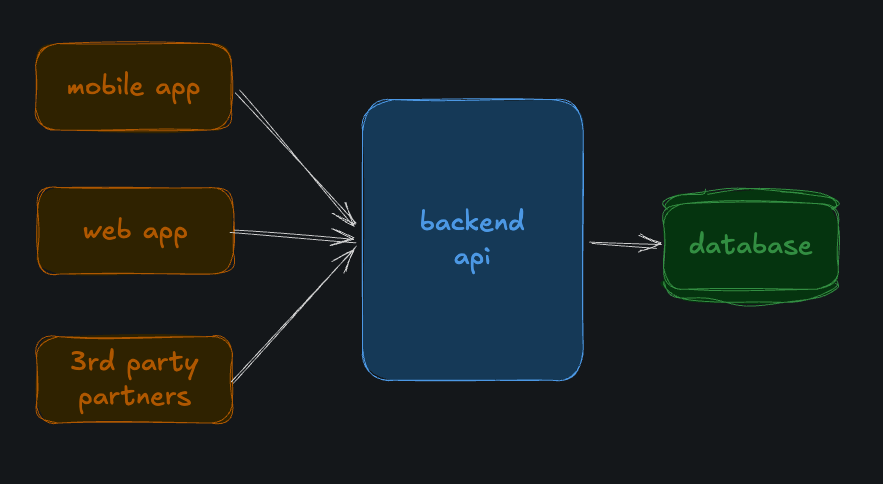
I recommend becoming familiar with a SQL database first, probably PostgreSQL. After that, get familiar with NoSQL options at a high level so you can hold your own in interviews.
Resources
At this stage, focus on modeling data, writing basic queries, and connecting a database to a real backend project.
- Boot.dev’s backend path in Python and Go
- Boot.dev’s backend path in Python and TypeScript
- Learn SQL
- Our top backend technologies
- StrataScratch DB practice
- Codecademy
- Collection of resources on Momer’s GitHub
Technologies to read up on:
- PostgreSQL
- MySQL
- SQLite
- Elasticsearch
- Docker
- CockroachDB
- Redis
Upgrade one of your earlier projects to use a database.
6. Deploy projects to your professional portfolio
Finally, deploy some projects. This is how you prove to employers that you can build real software as a self-taught developer. For backend roles, it’s less about fancy design and more about solid code and delivery.
In order of importance, work on:
- A strong GitHub profile
- Great
README.mdfiles on your top three public repos - At least one project deployed to the internet with either a frontend or API documentation for Postman/cURL
- Listing your projects clearly on your resume
Deploying projects improves your online presence and gives you the production practice you’ll need on the job.
7. Start looking for a backend job
The big secret to landing a backend job as a self-taught developer is to build an online presence that showcases your work.
- Put effort into your public GitHub profile
- Build open-source projects
- Contribute to existing open-source projects
- Build a great LinkedIn profile and network
- Make friends in online coding communities
Then start applying. Use every job board you can find, and target jobs that match your stack (for example, backend Go roles). Niche job boards can help, too, like Golang Cafe.
Full backend developer roadmap (visual)
Below is a full visual roadmap you can follow from beginner to job-ready backend developer.
START
  |
  +--> 1) Programming Basics
  |      - Variables, functions, loops, data structures
  |      - Learn one language deeply (Go/Python/TypeScript)
  |
  +--> 2) CS Fundamentals
  |      - Big-O, arrays, linked lists, trees, hash maps
  |      - Sorting, searching, recursion, graph basics
  |
  +--> 3) Web Fundamentals
  |      - HTTP, DNS, client-server model, REST basics
  |      - Build tiny apps to understand request/response flow
  |
  +--> 4) Backend Development Essentials
  |      - Build APIs (routing, validation, status codes)
  |      - Framework familiarity (Gin/FastAPI/Express/Nest)
  |      - AuthN/AuthZ (sessions, JWT, permissions)
  |      - Caching (Redis fundamentals)
  |
  +--> 5) Databases
  |      - SQL first (PostgreSQL): schema design, joins, indexes
  |      - NoSQL basics (MongoDB/Redis) and tradeoffs
  |
  +--> 6) Software Quality
  |      - Clean code and maintainable project structure
  |      - Layered architecture: routes -> services -> data access
  |      - Testing basics and observability-friendly logging
  |
  +--> 7) Deployment and Cloud
  |      - Linux/terminal/Git workflow
  |      - Containers (Docker), orchestration basics (Kubernetes)
  |      - Cloud fundamentals (AWS/GCP/Azure)
  |      - Infrastructure as code (Terraform basics)
  |
  +--> 8) Scale and Reliability
  |      - Load balancing, concurrency, distributed systems basics
  |      - Event-driven systems (RabbitMQ/Kafka)
  |      - Monitoring, telemetry, and incident response practices
  |
  +--> 9) Portfolio + Job Search
         - Public GitHub, polished READMEs, deployed projects
         - Resume + networking + focused applications
         - Keep building while interviewing
Additional backend developer skills to learn while searching for a job
While you’re applying for jobs, it’s a great time to strengthen foundational skills that make backend developers effective in real production environments.
Core foundations
Strong backend developers understand the environment their code runs in, not just the language they write.
How to use a terminal on your OS of choice
Every backend developer should be comfortable in the terminal. At a minimum, you should know how to:
- Navigate directories with commands like
cd,ls, andpwd - Create, move, and delete files and directories
- Run scripts and programs
- Manage environment variables
- Use package managers and basic shell tools
If you’re on macOS or Linux, you’ll likely use Bash or a similar shell. On Windows, you’ll often use PowerShell or Command Prompt, though Bash is available through WSL.
Version control
Version control is how developers collaborate, track changes, and avoid losing work. Git is the standard.
You should understand:
- Initializing a repository
- Staging and committing changes
- Branching and merging
- Resolving merge conflicts
- Pull requests and collaboration workflows
Runtime and operating system fundamentals
Backend apps don’t run in isolation. They run inside operating systems, often alongside other services.
You should have a basic grasp of:
- Processes and process creation
- Threads and concurrency at a high level
- Memory management concepts
- File systems
- Environment variables and configuration
- How programs start, run, and terminate
Backend development essentials
Once you understand the fundamentals, learn the core building blocks of real backend systems.
- Frameworks for building backend applications: Frameworks help with routing, request handling, and database integration. Examples include Django/FastAPI for Python, Express/NestJS for Node.js, and Gin for Go. You don’t need all of them - go deep on one.
- RESTful APIs and service communication: Learn route design, HTTP methods, JSON payloads, validation, errors, and status codes.
- SQL and NoSQL databases: Understand when to use relational databases like PostgreSQL and when NoSQL tools like MongoDB or Redis make sense.
- Authentication and authorization: Learn sessions, tokens, and standards like JWT.
- Caching fundamentals: Learn what to cache, when to cache, and how tools like Redis reduce latency and load.
Writing maintainable software
Backend systems grow over time, and messy code gets expensive quickly.
- Clean code principles: Write readable, consistent code with clear naming and small focused functions.
- Clean architecture patterns: Separate business logic from delivery and data layers so code is easier to test and change.
Cloud infrastructure and deployment
After building a backend app, you need to make it accessible to real users.
- Containers and orchestration: Docker for packaging apps, Kubernetes for managing workloads, Helm for deployment config management.
- Cloud engineering fundamentals: Learn virtual machines, managed databases, storage services, networking, and permissions.
- Infrastructure automation: Use Terraform or cloud-native templates to define infrastructure as code.
Networking and scaling systems
As your app grows, traffic patterns and system complexity grow with it.
- Networking fundamentals: DNS, load balancers, and internal routing.
- Concurrency basics: Threads, async models, workers, and throughput tradeoffs.
- Distributed systems concepts: Reliability vs consistency tradeoffs, network failures, and partial outages.
- Event-driven architecture: Async communication with brokers like RabbitMQ and Kafka.
Reliability and production operations
Deploying is not the final step - running reliably in production is.
- Monitoring: Track CPU, memory, error rate, and latency with tools like Prometheus or Datadog.
- Telemetry: Use logs, metrics, and traces to understand live system behavior.
- Reliability engineering: Apply SRE practices like SLIs/SLOs, alerting, and incident reviews.
Advanced specializations
After you’ve built a strong foundation, specialized topics can set you apart.
- Cryptography foundations: Understand hashing, encryption in transit, and secure defaults like HTTPS.
- Machine learning: Some backend roles involve serving model inference APIs and maintaining ML workloads.
My favorite backend programming languages
You can be a backend programmer in almost any language, but here are some of my favorites in descending order:
- Go - A modern, simple language that’s great for performant general-purpose servers
- TypeScript - A typed superset of JavaScript that’s great for web apps
- Python - Elegant and productive for many backend services
- JavaScript/Node.js - Great for web apps, especially full-stack teams
- Rust - More complex, but extremely fast and reliable
- C# - Strong fit for Microsoft-heavy ecosystems
- Java - Tried and true for enterprise systems
- Ruby - Great if you enjoy Rails and Ruby’s style
- PHP - Great for simple websites, less great for many modern APIs
Here’s a complete write-up on the best backend programming languages.
Learn backend development - and have fun doing it
If you’ve made it this far, you now have a clear picture of what the journey looks like. It’s a lot to learn, but it’s manageable when you take it one step at a time.
Most importantly, do not stop learning and building. I’ve seen many developers think they’ve learned enough and switch entirely to job applications. Applying only takes an hour or two each day - use the rest of your time to keep building. The more you build, the easier the job search gets.
Good luck out there - you’ll do great.
If you’re looking for a fun, structured way to stay consistent and keep growing in backend development, Boot.dev gives you a clear path forward. Instead of hopping between scattered tutorials, you follow a focused, gamified roadmap with hands-on coding, challenges, and real projects.
The platform keeps your attention on what matters most, helping you sharpen backend skills without getting pulled into frontend-heavy distractions.
Start learning backend development on Boot.dev.
Frequently Asked Questions
How to become a backend developer?
Becoming a backend developer is about building strong fundamentals and proving you can create real systems. Learn one programming language deeply (such as Python, Go, or JavaScript), study data structures and databases, build and deploy real projects, and apply consistently while continuing to improve your portfolio.
How long does it take to become a backend developer?
Most people can become job-ready in 9 to 18 months with consistent part-time study. The timeline depends on how many hours you practice each week, whether you are starting from zero or already have experience, how consistently you build projects, and how focused you stay on one stack.
Should I learn everything on the backend roadmap?
No. The roadmap covers a wide range of topics, but you do not need to master everything immediately. Start with core fundamentals and real projects, then branch into advanced areas based on your interests and career goals.
What tools does a backend developer use?
Backend developers use languages such as Python, Go, or JavaScript to build applications. They work with databases, Git for version control, tools like Docker for packaging applications, and often cloud and monitoring platforms.
What are backend frameworks?
Backend frameworks are libraries that provide structure for building server-side applications. They handle common tasks like routing requests, processing input, and connecting to databases. Examples include Django, FastAPI, Express, and Gin.
How long does it take to learn backend development?
If you are starting from zero, it usually takes about 9 months to 2 years to learn backend development thoroughly enough to land an entry-level role. A steady pace of around 10 focused hours per week is a strong baseline.
Do I need to start with frontend development?
No. You do not need to start with frontend if your goal is backend. Learning frontend basics can still help, but it is not a required prerequisite and can be a distraction from backend-focused goals.
Do I need to learn DevOps?
Not deeply before your first job. You should know how to deploy simple backend apps, but your main focus should be writing code and shipping projects. Learn core DevOps basics, especially when job postings require them.
Why not just take a backend development course?
You can, but many courses are optimized for full-stack or frontend outcomes and gloss over core backend fundamentals. A focused self-taught roadmap helps you control what you learn, what you build, and where you specialize.
Related Articles
Put that Framework Down Before Someone Gets Hurt
Nov 06, 2023 by lane
There is only one question that ignites my inner rage more than “How do I get a developer job in 3 months?”? That question is:
What is Backend Web Development?
Aug 07, 2023 by natalie
The boring answer is that backend web development is the process of building the server-side of websites and web applications. It primarily focuses on handling the logic, data processing, and communication between the user’s web browser and the server.
The Pros and Cons of Django for Backend Development
Jul 17, 2023 by natalie
Django is a popular Python-based framework for building web applications. It provides pre-built components and conventions, which simplifies the web app development process and allows developers to focus on writing their application’s specific logic rather than dealing with repetitive tasks. Basically, it’s all about reusability.
I Mock Your Mocks
Jul 13, 2023 by lane
Several years ago I started my first job as a “senior” Go developer. You see, after a modest 3 years in the industry, my arcane ability to use the Go standard library’s strings.Contains() function managed to leave a powerful impression on the hiring team.