Base64 vs Base58 Encoding

Last published November 3, 2020
Base64 is one of the most popular encoding formats for representing data. Have some binary data? Base64 encodes it for convenient readability and parsing. Base58 is just another encoding format (with 58 characters instead of 64, and has gained popularity largely due to Bitcoin and other cryptocurrencies. Also, if you came here confused, encryption and encoding are not the same! Take a look at this article for more information on encryption vs encoding.
When it comes to data encoding, there is typically a trade-off made between:
- Human Readability: Do humans have a good idea of what is being represented at a glance?
- Efficient data compression: How many bytes are used to represent the same data, and how many characters are available?
Let's rank Base58, Base64, and ASCII encoding against each other using these metrics!
First: A Note on Binary
All data is stored in a raw binary format on computers. These encoding formats (Base64, Base58, and ASCII) are just different ways of reading and writing binary data. For example, in Base64 the binary code 000000 represents the letter A, but in ASCII the binary 00000000 represents the NUL character.
ASCII Encoding
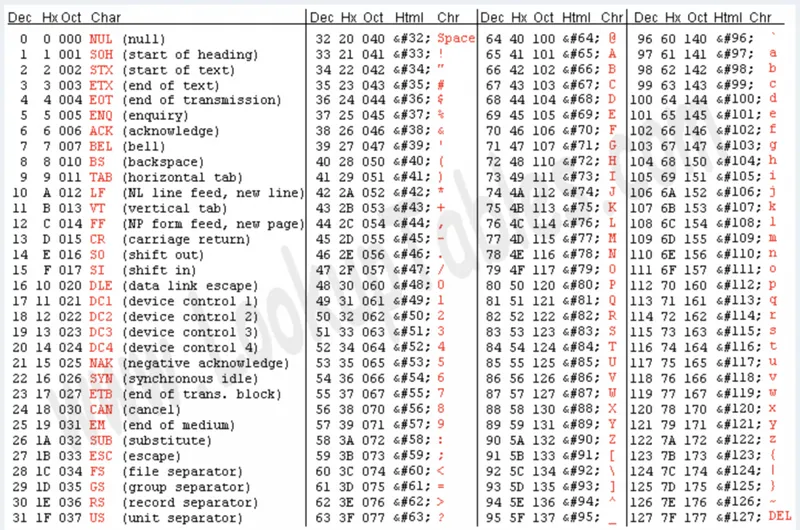
Human Readability Rank: 1st
Not all human language characters are possible using ASCII, but the most important ones are. ASCII is meant to be used in applications that need a simple way to represent Latin-based text, Arabic numerals, and formatting characters like newlines and spacing. ASCII is based on how typewriters worked in the pre-computer days.
Data Compression Rank: 3rd
Each character (typically) takes an entire byte (8 bits) of data. To represent the NUL character, we need to store 00000000, which is a lot of wasted zeros! It is worth noting that ASCII can work with only 7 bits, but because computers work in base-2, it is more simple to use a full byte.
You could also call ASCII Base128 because its alphabet is made up of 128 characters.
Base64
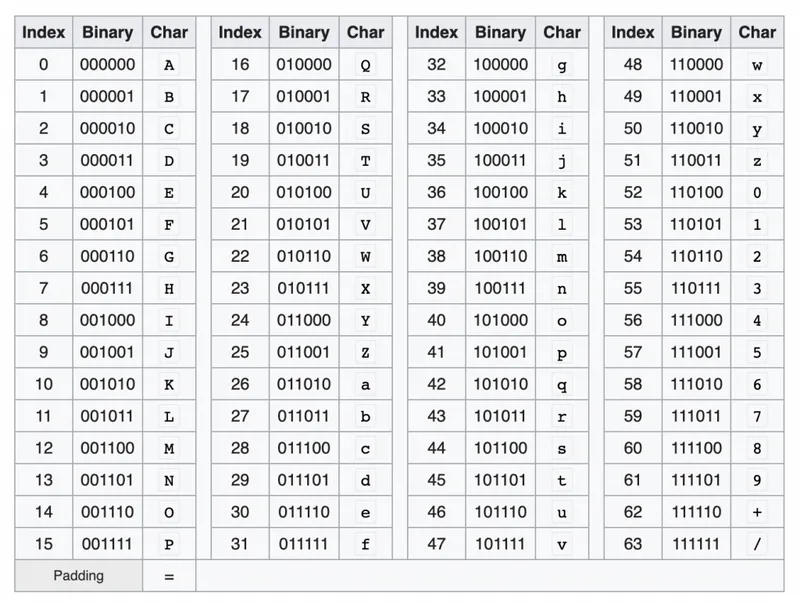
Human Readability Rank: 3rd
Base64 is designed to carry data stored in binary formats across channels that only reliably support text content
Base64 was essentially designed to trick computers... kind of. When we have binary but are only allowed to transport or display text, Base64 is a great choice.
Data Compression Rank: 2nd
Each character only takes 6 bits of data, and a padding character, =, is used to round to the nearest multiple of 4.
Base58
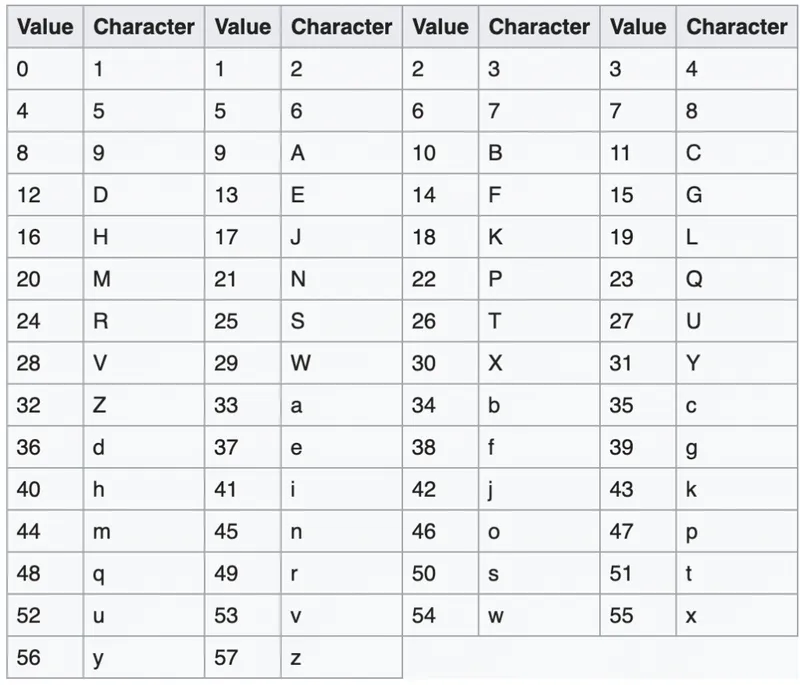
Human Readability Rank: 2nd
Satoshi Nakamoto, also the anonymous creator of Bitcoin, invented Base58. The goal was to get data compression levels comparable to that of Base64 but to make it easier for humans to read by eliminating characters that look similar to 0 (zero), O (capital o), I (capital i), l (lower case L). Alphanumeric characters + (plus) and / (slash) were also omitted for readability.
Data Compression Rank: 3rd
Very similar to that of Base64, but due to 6 fewer characters, not quite as efficient. Additionally, the parsing is slightly more awkward due to the base not being a power of 2.