Create a Golang Video Streaming Server Using HLS

Last published September 4, 2020
In this tutorial, we’ll go step-by-step through building a video streaming API (which will work for music as well) in Go. Don’t worry, it’s surprisingly easy to build a robust media streaming server, especially if we utilize a modern communication protocol, HLS.
What is HLS?
HTTP Live Streaming is an HTTP-Based adaptive bitrate streaming communications protocol developed by Apple.
HLS is a streaming protocol that allows large media files to be served as many smaller text files that are broken up into roughly ~10-second increments. By breaking them up, the user’s client-side application only needs to buffer ~10 seconds in advance. This saves the user a lot of potential bandwidth and allows songs or videos to start playback almost immediately.
Using FFmpeg, we can easily convert mp3 files to HLS format, which consists of multiple files. One of these files contains the metadata (.m3u8) and is served first. This metadata file tells the client where to get each data file, and what each data file contains. The data files have a .ts extension and typically contain ~10 seconds of audio and are served one-at-a-time at the client’s request.
Get Started - Format Some Media for your Server
Download a sample .mp3:
http://www.hubharp.com/web_sound/BachGavotteShort.mp3
Install FFmpeg. If you are on a Mac:
brew install ffmpeg
Navigate to the directory of the mp3 file and run:
ffmpeg -i BachGavotteShort.mp3 -c:a libmp3lame -b:a 128k -map 0:0 -f segment -segment_time 10 -segment_list outputlist.m3u8 -segment_format mpegts output%03d.ts
This should result in three new files:
output000.ts output001.ts outputlist.m3u8
Congratulations! You are done with the hard part, you now have simple files that can be served over HTTP. Any modern client-side media library will know how to read HLS files.
Building the Streaming Server
As I eluded to above, HLS is very simple on the server-side. All we need to do is serve a path to the .m3u8 file, and make sure the .ts files are served from the same path. In traditional file server architecture, this just means that they need to be in the same directory.
Let’s set up our project with the following folder structure:
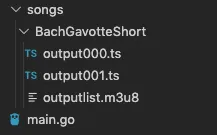
Copy the following code into main.go:
package main

import (
	"fmt"
	"log"
	"net/http"
)

func main() {
	// configure the songs directory name and port
	const songsDir = "songs"
	const port = 8080

	// add a handler for the song files
	http.Handle("/", addHeaders(http.FileServer(http.Dir(songsDir))))
	fmt.Printf("Starting server on %v\n", port)
	log.Printf("Serving %s on HTTP port: %v\n", songsDir, port)

	// serve and log errors
	log.Fatal(http.ListenAndServe(fmt.Sprintf(":%v", port), nil))
}

// addHeaders will act as middleware to give us CORS support
func addHeaders(h http.Handler) http.HandlerFunc {
	return func(w http.ResponseWriter, r *http.Request) {
		w.Header().Set("Access-Control-Allow-Origin", "*")
		h.ServeHTTP(w, r)
	}
}
Now run the server:
go run main.go
Your server is live! Test your code and listen to the music stream by using an HLS media client. You can find a free online client here
Simply paste your song’s URI and listen:
http://localhost:8080/bachgavotteshort/outputlist.m3u8
Related Articles
Should You Return Empty or Nil Slices in Go?
Sep 03, 2020 by Lane Wagner - Boot.dev co-founder and backend engineer
In Go, we often need to return zero values. Idiomatic Go encourages the use of guard clauses, and guard clauses necessitate the need to return early. When returning early with an error, by convention all other return values should be zero values. The confusion arises with data types like maps and slices. Should maps and slices be returned as a simple nil value, or should an empty but instantiated value be returned?
Top 15 Golang Interview Questions [Updated 2026]
Aug 31, 2020 by Lane Wagner - Boot.dev co-founder and backend engineer
Let’s take a look at some good technical questions to be familiar with, whether you are looking to nail your next Golang interview, or if you’re the interviewer yourself..
Unexpected Printf Behavior in Go WASM - Nothing Prints
Aug 10, 2020 by Lane Wagner - Boot.dev co-founder and backend engineer
While working on boot.dev’s Go Playground, I came across a very strange error. The standard library’s fmt.Printf() function prints nothing to the console when called. Nothing.
Authenticate Users with "Sign In With Google" in Golang
Jul 22, 2020 by Lane Wagner - Boot.dev co-founder and backend engineer
Users love convenience. If your goal is to make it easy for users to register with your app or website, then implementing the “Sign in with Google” option should be at the top of your priority list. If you are like me, then you may find Google’s documentation on the subject to be lackluster at best, and downright confusing at worst. Here we will go step-by-step through the authentication process so you can implement Google sign-in easily.