Top 4 Coding Languages To Learn For Beginners in 2026

Last published February 21, 2026
Coding languages, tools, and frameworks are in a constant state of flux, improvement, deprecation, and popularity swings. Let’s take a look at the top 4 languages for new programmers to learn in 2026.
As it happens, we support all four of the top languages on the boot.dev app, and have courses for JavaScript and Go, with Rust and Python courses in active development. If you are interested in furthering your career, be sure to check it out.
1. JavaScript
Created: 1995 by Brendan Eich
JavaScript has truly become the language of the web. JavaScript is the only language (besides the barely-supported Web Assembly) used in frontend web development. Because it’s the only language that runs in the browser, and Node.js allows JavaScript to be used on the backend, JavaScript is really the only language that can do both frontend and backend well.
JavaScript is one of the older languages on this list, but despite its age, it has withstood the test of time. Some would argue (including myself) that JavaScript has stayed relevant not because of its great design, but because it’s the only scripting language that all the major browsers supported.
That said, JavaScript has had major syntax and design improvements over the last several years, especially with ES6. The modern version of the language is much more fun to work with.
Who Should Start With JavaScript?
Anyone who wants to get up and running building web applications as quickly as possible. You may miss out on some of the fundamentals of how computer hardware and operating systems work at a lower level, just be sure to go back and learn as you grow as a developer.
2. Go
Version one released: 2012 by Google
Go has become a powerhouse in several scenarios:
- Micro-services and backend web development
- Distributed systems and blockchain technology
- DevOps work
Go is a compiled language, which means it runs much faster than its interpreted counterparts like JavaScript and Python. Being compiled also means that by learning Go, you will learn more about how operating systems, static typing, and CPU architecture play a role in programming.
Go is known for having a rich standard library, particularly when it comes to backend web features. For example, to write a web server in Python or JavaScript, you would likely use a framework like Express, Django, or Flask to make up for the missing functionality. In Go, the standard HTTP library is powerful enough to build production servers without importing any large dependencies.
Who Should Start With Go?
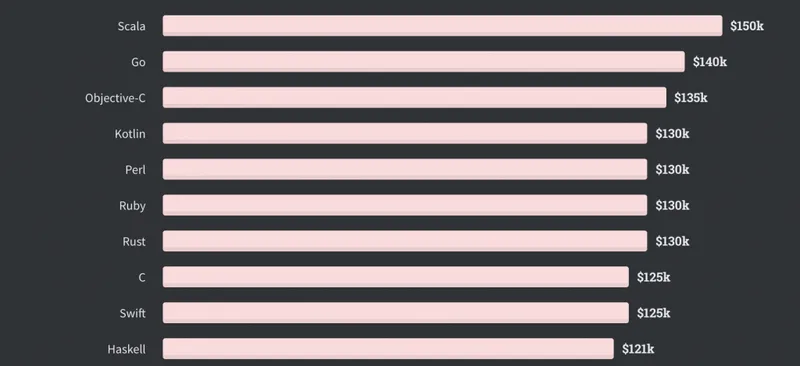
Anyone interested in DevOps or backend development should learn Go. You will likely need to learn about some technologies (Docker, Kubernetes, Postgres, etc) before landing a job, but it will be worth it considering Go is the second-best paying language in the US this year.
3. Python
Created: 1991 by Guido van Rossum
Python is a joy to write, at least when you aren’t fighting migrations between Python 2 and Python 3. Python boasts simple syntax, is installed by default on most Linux machines, and has rich scientific and machine learning libraries and frameworks.
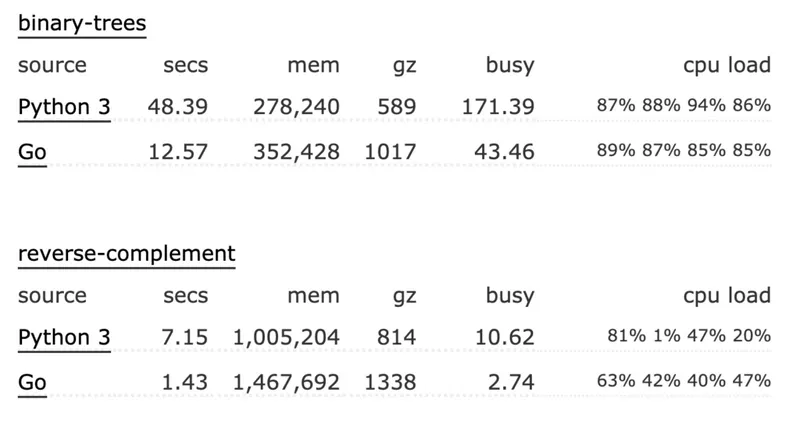
While Python is definitely the slowest language on our list, it makes up for its lack of speed in other key areas:
- Writing code is fast and easy - the code runs slow but can be written and shipped quickly
- Is useful for simple tasks like shell scripting, as well as complex production web servers
- Has some of the best scientific, mathematic, and machine learning libraries (SciPY, NumPY, Tensorflow)
Who Should Start With Python?
Python is great for educational purposes, particularly for learning computer science basics like data structures and algorithms. Python allows students to focus on the concepts at hand, because the syntax is second nature.
Python is also a great first choice if you have an interest in machine learning. Python is basically the go-to language for AI/ML and Tensorflow is the state of the art in that field.
4. Rust
Version one released: 2015 by Graydon Hoare
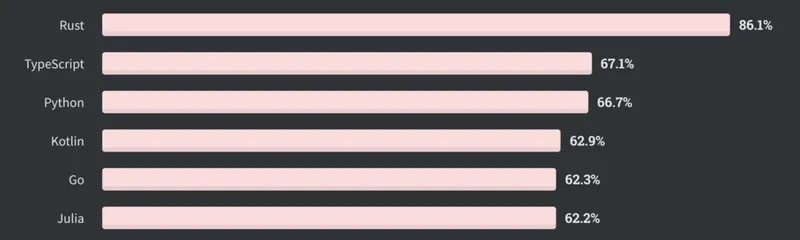
Rust is the most loved language of 2020 by a significant margin.
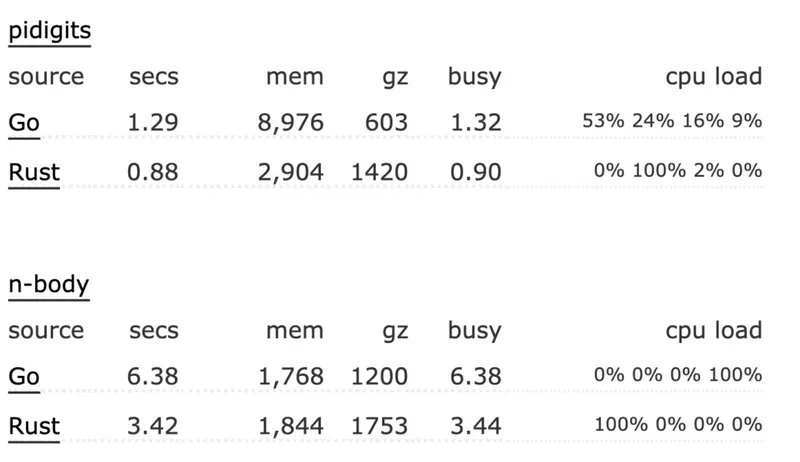
Rust stands alone as the fastest language on this list, and in many cases, is one of the fastest languages in existence. Rust excels at being hyper-performant and memory-efficient while still boasting a modern development toolchain and dependency management system.
Rust gives the programmer fine-grained control over how the code interacts with the hardware, which makes it a great replacement for C in embedded systems programming. Rust also gives the developer the power to optimize the compiled executable in various ways which ultimately means more performant code.
Rust is used in backend web development like Go but has really found its place as a systems language.
Who Should Learn Rust First?
Honestly, you probably shouldn’t learn Rust first. That said, Rust is arguably the best second language on the list. Rust is probably the most complex language on this list, but along with that complexity comes power, speed, and ultimately the opportunity for the developer to learn more about how code interacts directly with the hardware.
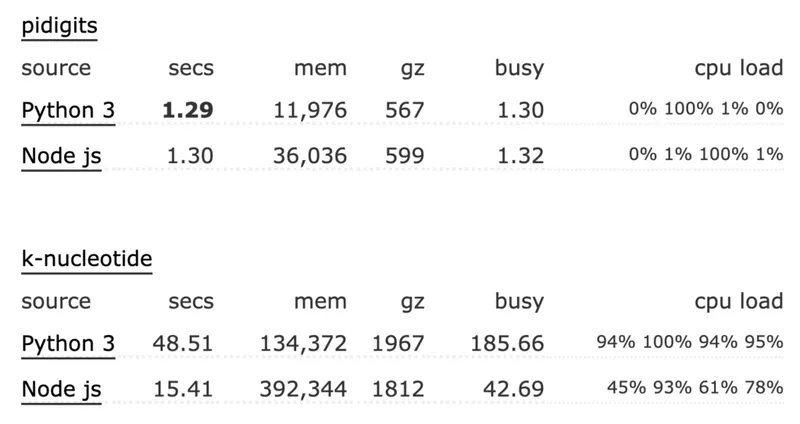
Performance Benchmarks
Go vs Rust
Python vs Go
Python vs JavaScript
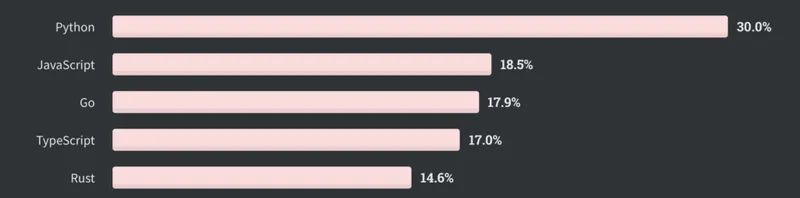
Relevant Stack Overflow Popularity Graphs
Go and Rust are well payed
Rust, Python and Go are loved
Python, JavaScript, Go and Rust are all wanted
Related Articles
Education's Shameful State of the Art
Oct 05, 2020 by Lane Wagner - Boot.dev co-founder and backend engineer
Higher education had its problems before Covid-19. Now the crippling inefficiencies, backbreaking cost, and lack of alternatives are being forced into the spotlight. We’re working on what will eventually grow into the alternative to overpriced universities and ineffective Bootcamps at boot.dev. In the meantime, let’s take a look at education’s biggest problems, and how we can solve them.
Practical Patterns for Technical Writing
Sep 22, 2020 by Ben Barten
Writing technical documents like API or architectural documentation which exceeds a simple flow diagram can be a daunting task. If you have some experience with technical documents, you will probably agree that there is nothing more frustrating than bad documentation.
Your Parent's Internet - How to Mitigate Misinformation
Jul 31, 2020 by Lane Wagner - Boot.dev co-founder and backend engineer
The age of information is not what we all hoped it would be. We successfully digitized the majority of human knowledge, and we even made it freely accessible to most. Now the problem is different, we have too much information. Answers to most questions can be found in thousands of distinct places online, and the new problem is “whose information can we trust?”
How to Get Consistent Line Breaks in VS Code (LF vs CRLF)
Jun 18, 2020 by Lane Wagner - Boot.dev co-founder and backend engineer
Have you ever had the problem where you submit a pull request and the diff is much larger than it should be? Maybe the code looks identical, but GitHub tells you it’s completely different.