Nvidia CEO: AI Doomers Could Cause a Software Engineer Shortage

Last published April 23, 2026
It feels like every week Dario (Anthropic’s CEO) is yelling about how AI is going to destroy white-collar jobs, particularly software engineering jobs. Well, in April 2026, about 4 years into the “in 6 weeks, AI is taking your coding job” cycle, Nvidia CEO Jensen Huang is finally talking about the potential consequences of that narrative:
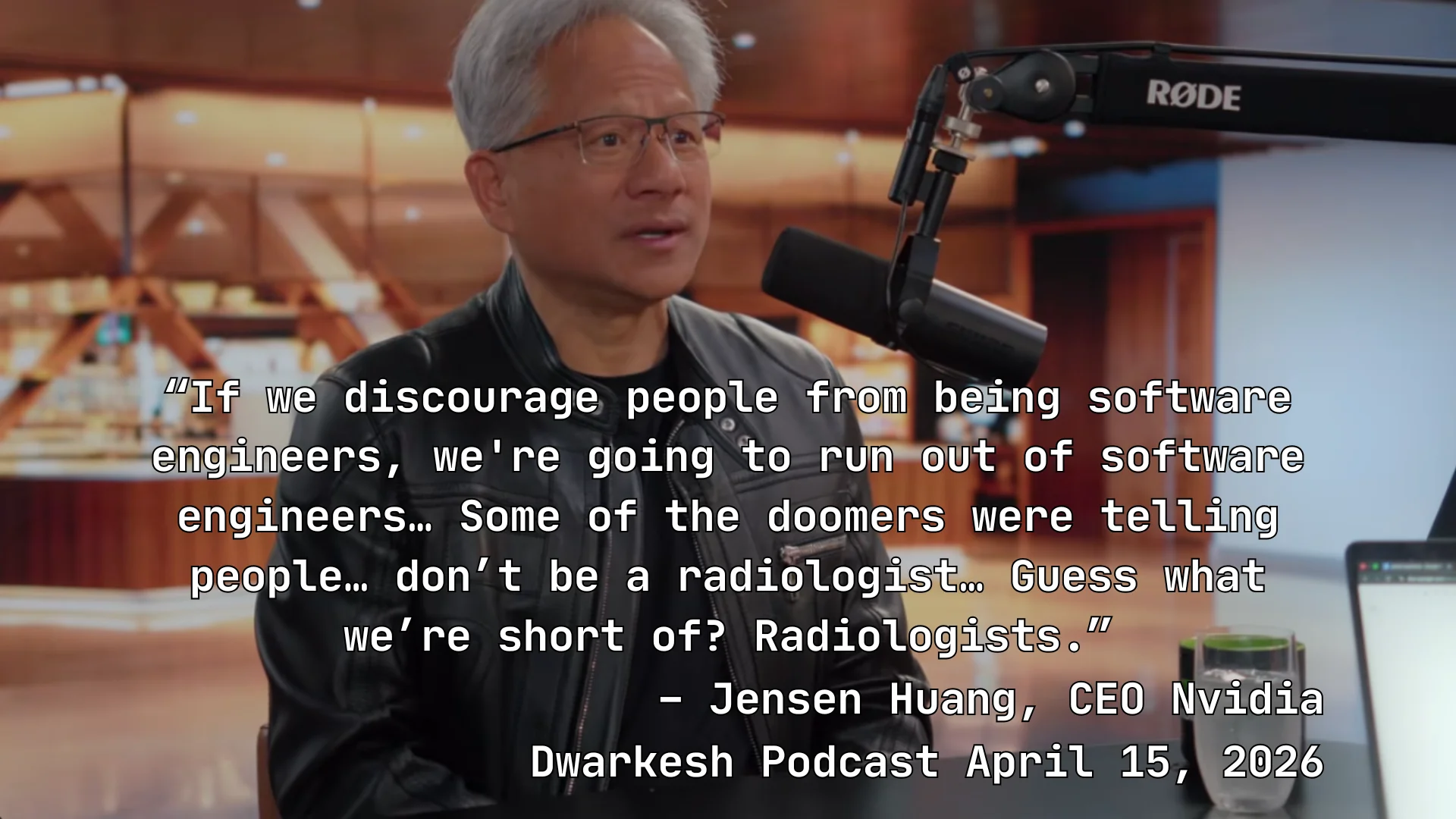
“This is one of the concerns that I have about the doomers describing the end of work and killing of jobs.
If we discourage people from being software engineers, we’re going to run out of software engineers. The same prediction happened ten years ago. Some of the doomers were telling people, ‘Whatever you do, don’t be a radiologist.’
You might hear some of those videos still on the web saying radiology is going to be the first career to go and the world is not going to need any more radiologists. Guess what we’re short of? Radiologists.”
– Jensen Huang, CEO of Nvidia, in a recent interview with Dwarkesh Patel.
I just spent a full 8 hours coding with AI yesterday (not that I haven’t done that before, it was just a particularly long session). I was swapping between Opus 4.7 and GPT 5.4, and while I usually do feel somewhere between 25 and 50% more productive, yesterday I was pulling on that stochastic slot machine lever and just never really hit the jackpot. Each agentic turn was taking 15-20 minutes, and I was getting a ton of bloated buggy code that I then had to manually dig into and try to coerce the model into fixing… it was exhausting, slow, and most importantly, unproductive.
We have 5 full-time engineers at Boot.dev, and I still don’t see how AI is even close to being able to replace them.
Maybe it’s a skill issue.
Maybe I’m biased (I am) because a strong coding jobs market is good for my business (Boot.dev).
Sometimes I’ll one-shot a task, but sometimes I’m be led on a wild goose chase when I could have done it myself much faster. Again, on average, I’m seeing low double-digit productivity gains. My suspicion is that for some companies, that’s enough to lay off some internal tooling engineers. But for companies where development is a profit center and not a cost center, the cost of software engineering going down by ~20% should increase demand for engineers, not decrease it.
Now, many features and bug fixes that “weren’t worth it” all of a sudden are.
Jevons paradox at work? We’ll see.
Related Articles
The Boot.dev Beat. April 2026
Apr 08, 2026 by Lane Wagner - Boot.dev co-founder and backend engineer
March was a monster month. We shipped the new DevOps learning path (18 DevOps courses!), 2 brand new courses, upgraded the in-browser Python coding experience, and made Boot.dev noticeably better on phones.
Boot.dev's New Logo Unveiled
Mar 19, 2026 by Lane Wagner - Boot.dev co-founder and backend engineer
We created our old blue/black/gray logo years ago before we redsigned the site to its new gold/brown/blue textured look and feel. As such, the old logo just doesn’t fit at all with the current state of the brand (as much as we loved it). So, we decided to work with an incredible designer (thanks Dusan!) to create a new logo that really captures what Boot.dev has become over the years.
The Boot.dev Beat. March 2026
Mar 12, 2026 by Lane Wagner - Boot.dev co-founder and backend engineer
February was stacked with quality-of-life work and platform upgrades. A lot of this work is infrastructure-heavy and not quite as flashy, but it makes Boot.dev faster, sturdier, and more fun to use. Also: the DevOps learning path is very close. The AWS and logging courses are getting their final polish and should be landing any week now.
The Boot.dev Beat. February 2026
Feb 11, 2026 by Lane Wagner - Boot.dev co-founder and backend engineer
A new year and another record broken! In January a combined 4,016,641 lessons and challenges were completed by you, dear pupils! And to top it off, we’re now releasing the much anticipated Power BI Course by none other than Alex the Analyst! I hope you enjoy it.