How To Correctly Validate Passwords - Most Websites Do It Wrong

Last published October 15, 2020
You’ve probably visited a site and attempted to sign-up only to be met with errors such as:
- Password needs a capital letter
- Password needs a special character
- Password needs to be at least 8 characters
I just released a package in Go that solves this problem. Check it out and give it a star here: go-password-validator. If you want to understand how it works, and how to properly validate user passwords, read on.
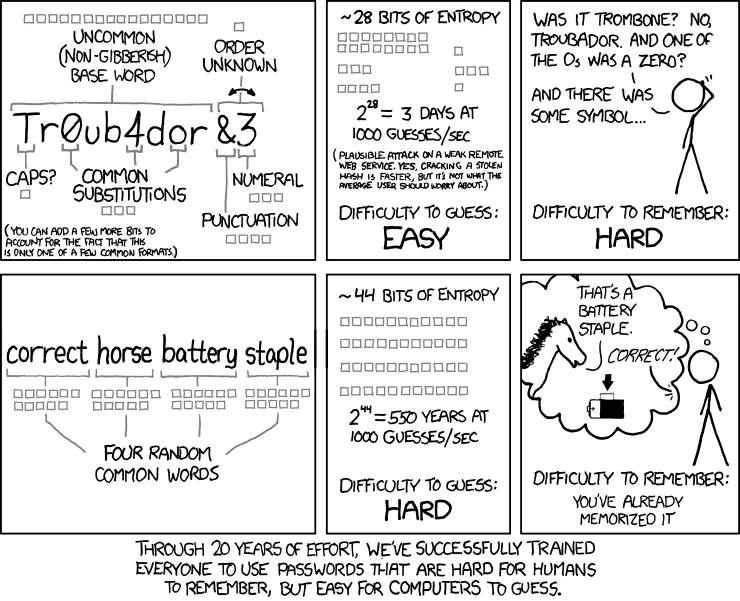
Not only are the rules above quite annoying, but they can also be a security flaw in the system. Take for example a strong passphrase: super worm eaten human trike. That passphrase has plenty of entropy (randomness) but it wouldn’t pass the first two validation steps given above. XKCD puts this best:
The Problem - Allow Users to Use Any Password Format as Long as It Has Enough Entropy
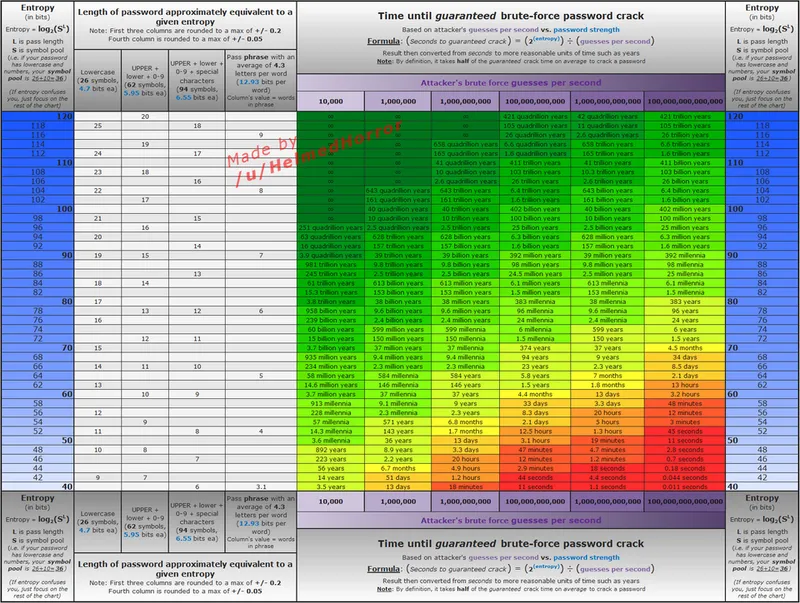
We don’t care if a password only has lowercase letters if it’s long. All that matters is the entropy. Entropy in this context refers to the number of brute-force guesses it would take to guess a password, and we measure it in bits (the exponent in 2^n). Refer to the following chart to see how various entropy levels contribute to the time it takes to brute force a password.
How To Determine Entropy Given a Password
The way go-password-validator works is my favorite (obviously, I wrote it), but there is certainly room for improvement. Let’s take a look at the process. From its Readme:
First, we determine the “base” number. The base is a sum of the different “character sets” found in the password.
The current character sets include:
- 26 lowercase letters
- 26 uppercase
- 10 digits
- 32 special characters -
!"#$%&'()*+,-./:;<=>?@[\]^_{|}~
Using at least one character from each set your base number will be 94: 26+26+10+32 = 94
Every unique character that doesn’t match one of those sets will add 1 to the base.
If you only use, for example, lowercase letters and numbers, your base will be 36: 26+10 = 36.
After we have calculated a base, the total number of brute-force-guesses is found using the following formulae: base^length
A password using base 26 with 7 characters would require 26^7, or 8031810176 guesses.
Once we know the number of guesses it would take, we can calculate the actual entropy in bits using log2(guesses)
Related Articles
Elliptic Curve Cryptography: A Basic Introduction
Sep 17, 2020 by Lane Wagner - Boot.dev co-founder and backend engineer
Elliptic Curve Cryptography (ECC) is a modern public-key encryption technique famous for being smaller, faster, and more efficient than incumbents. Bitcoin, for example, uses ECC as its asymmetric cryptosystem because it is so lightweight. The mathematical entity that makes all of this possible is the elliptic curve, so read on to learn how these curves enable some of the most advanced cryptography in the world.
Is AES-256 Quantum Resistant?
Sep 10, 2020 by Lane Wagner - Boot.dev co-founder and backend engineer
With quantum computers getting more powerful each year, many worry about the safety of modern encryption standards. As quantum computers improve in performance and the number of qubits used for calculations increases, current cryptosystems are under threat. AES-256 is one of the most powerful symmetric ciphers, but will it remain secure in a post-quantum world?
Bcrypt Step by Step
Aug 24, 2020 by Lane Wagner - Boot.dev co-founder and backend engineer
Bcrypt is a key derivation function, which can be thought of as a special kind of hash function. Its purpose is to slowly convert a piece of input data to a fixed-size, deterministic, and unpredictable output. A common use case is to convert a password into an n-bit cryptographic key, which can then be used for safe authentication.
Shamir's Secret Sharing Step-By-Step
Aug 18, 2020 by Lane Wagner - Boot.dev co-founder and backend engineer
Adi Shamir’s Secret Sharing is a cryptographic algorithm that allows distinct parties to jointly share ownership of a single secret by holding shares. The original secret can only be reconstructed by using a minimum number of shares, which allows different parties to cooperate without the need to fully trust one another.