Basic Intro to Key Derivation Functions

Last published December 30, 2019
A Key Derivation Function, or KDF, is a cryptographic algorithm that derives one or more secret keys from a secret value. If you’ve ever needed to store a password in a database or create a private key from a password, you may have used a KDF. Some examples of popular KDFs are Argon2, Scrypt, and PBKDF2.
Are KDFs Just Hash Functions?
No, but there is overlap. To understand KDFs, let’s first go through a quick refresher on hash functions.
Some hash functions for example:
- SHA-256
- MD5
A hash function takes an input and creates an output. In most password hashing scenarios it looks something like this:
sha256("password123") -> ef92b778bafe771e89245b89ecbc08a44a4e166c06659911881f383d4473e94f
The function must have the following properties:
- It scrambles data deterministically (Same input, same output)
- No matter the input, the output of a hash function always has the same size
- It cannot retrieve the input from the output (one-way function)
So What’s the Difference?
There are different types of KDFs. Some are based on stream or block ciphers, but in this article, we will focus on the most common type, hash-based key derivation functions.
As it turns out, all hash-based KDFs are secure hash functions, but not all hash functions are hashed-based KDFs.
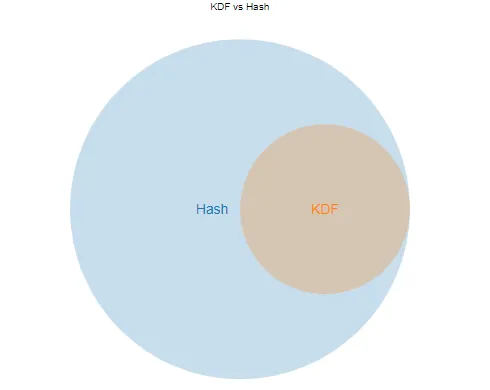
In addition to the properties of a hash function, KDFs can serve the following purposes:
- Key Stretching
- Key Whitening
- Key Separation
- Key Strengthening
Let’s look at each case separately, with the following definition of our general KDF in mind:
derivedKey = keyDerivationFunction(originalKey, salt, difficulty)
Salt is random data used to protect against pre-computation attacks or rainbow tables.
Difficulty can be used to make the KDF slower via intense computation, memory, or parallelism requirements. This protects against brute force attacks because it will take an attacker longer per guess.
Key Stretching
Key stretching is the most common use case for the average developer. The idea is to take a key with low entropy (security or randomness) and stretch it into a longer key that is more secure. Passwords are undoubtedly a great example. For example, many websites use Bcrypt to stretch keys:
passwordForDB = bcrypt(password, salt, difficulty)
Key Separation
KDFs allow child keys to be created from a master key. This can be used in applications like Bitcoin where child keys can control sections of a wallet. However, only the master has full control. This is done through the use of different salts. For example:
childOne = kdf(masterKey, saltOne, difficulty)
childTwo = kdf(masterKey, saltTwo, difficulty)
childThree = kdf(masterKey, saltThree, difficulty)
Key Strengthening
Strengthing extends a key with a random salt, but then deletes the salt so it can’t be used again. This makes the resulting key stronger without adding significant vulnerabilities to the system.
Should I Use KDFs?
Yes. Most often when storing passwords in databases, but also if any of these other use cases fall into the domain of your code. Tweet me if you have comments or questions. To read more check out the HKDF paper.
Related Articles
How to Secure Your Bitcoin
Aug 30, 2019 by Lane Wagner - Boot.dev co-founder and backend engineer
If you’re new to Bitcoin and cryptocurrency, you may have heard the common phrase not your keys not your coins. While self-custody isn’t for everyone, it’s the only way to truly have exclusive control over your funds. If that’s what you’re into, read on.
Security in Dependencies
Aug 21, 2019 by Lane Wagner - Boot.dev co-founder and backend engineer
Choosing the right dependencies is a difficult task. Assuming the developer of an application is the best programmer in the world, the “best” thing to do would be to write the entire codebase alone. This would eliminate the bugs, vulnerabilities, and malicious intrusions of inferior developers.
Creating and Remembering a Strong Passphrase
Aug 03, 2019 by Lane Wagner - Boot.dev co-founder and backend engineer
We all have hundreds of online accounts. Ideally, as many of those accounts as possible have unique passwords. Unique passwords however present a difficult problem.
BIP 32 Watch-Only Wallets
Jul 25, 2019 by Lane Wagner - Boot.dev co-founder and backend engineer
Bitcoin improvement proposal 32 is, in my opinion, one of the most important BIPs we have. (Thanks Peter Wuille!) BIP 32 gave us Hierarchical Deterministic Wallets, which grant the ability to create a tree of keys from a single seed.